2026, Of Women and Water: Submersion Stories in Eudora Welty's Fiction, by Sarah Gilbreath Ford
An ecofeminist reading of coming of age in Eudora Welty’s fiction
Eudora Welty, however, rewrites this standard female coming-of-age story by repeating a specific key scene. More than a dozen times in her narratives, a young woman encounters a body of water—a lake, a river, a whirlpool, or even a rain barrel. In every case, the character’s submersion signals her entry into an adulthood full of possible danger. When the submersion experience becomes a spiritual baptism, however, the enchanted natural world can empower female characters to counter human social structures that tend to leave them silent, ignored, or dead.
In crafting these submersion scenes, Welty upends the power dynamics of perspective. Against the corporate point of view of a town, society, or family, Welty writes the individual, submerged perspectives of women trying to create adult identities not defined by societal scripts. By positing an ecofeminist reading of Welty’s fiction, Of Women and Water: Submersion Stories in Eudora Welty’s Fiction argues that Welty’s texts seek a narrative that will safely land female characters in adulthood with the agency to tell their own stories of confinement, submersion, and escape.

2025, To Absent Friends: Eudora Welty's Correspondence with Frank Lyell, edited by Julia Eichelberger, published by University Press of Mississippi
A thoughtful compilation that chronicles a nearly fifty-year friendship with the renowned Mississippi writer
With over 350 complete or excerpted letters, most previously unpublished, To Absent Friends: Eudora Welty's Correspondence with Frank Lyell forms an epistolary narrative of Welty’s writing life and her nearly fifty-year friendship with Frank Lyell, a friend from Jackson, Mississippi. Also included in the text are extensive annotations to explain the letters’ myriad, often telegraphic cultural references. Early letters show both correspondents’ youthful exuberance as Lyell pursued graduate studies at Princeton and Welty, based in Jackson, visited New York whenever she could. They saw much to ridicule in the grown-up world they were entering, but their letters also convey deep admiration for music, literature, art, dance, and other cultural expressions.
Letters from the 1940s discuss Welty’s work in progress, Lyell’s wartime service in the Army Air Forces Intelligence, and his teaching jobs in North Carolina and Texas. In the 1950s, her mother’s health began to fail, and the civil rights movement and other world events hovered in the background of letters reporting on the Weltys’ challenging lives. As Welty’s fame grew, the friends continued to share gossip, descriptions of enjoyably bad movies, and reports on literature that moved them.
The friends’ final decade of correspondence includes playfulness alongside poignant reminders of their own aging. Becoming quieter, calmer versions of their youthful selves, they retained their delight in high and low culture, their veneration of art, and their love of the absurd. Taken together, these letters document a remarkable artist’s responses to her time and place and a sparkling friendship.

2022, Eudora Welty and Mystery: Hidden in Plain Sight, edited by Jacob Agner and Harriet Pollack, published by University Press of Mississippi
Contributions by Jacob Agner, Sarah Gilbreath Ford, Katie Berry Frye, Michael Kreyling, Andrew B. Leiter, Rebecca Mark, Suzanne Marrs, Tom Nolan, Michael Pickard, Harriet Pollack, and Victoria Richard.
Eudora Welty’s ingenious play with readers’ expectations made her a cunning writer, a paramount modernist, a short story artist of the first rank, and a remarkable literary innovator. In her signature puzzle-texts, she habitually engages with familiar genres and then delights readers with her transformations and nonfulfillment of conventions. Eudora Welty and Mystery: Hidden in Plain Sight reveals how often that play is with mystery, crime, and detective fiction genres, popular fiction forms often condescended to in literary studies, but unabashedly beloved by Welty throughout her lifetime. Put another way, Welty often creates her stories’ secrets by both evoking and displacing crime fiction conventions. Instead of restoring order with a culminating reveal, her story-puzzles characteristically allow mystery to linger and thicken. The mystery pursued becomes mystery elsewhere. The essays in this collection shift attention from narratives, characters, and plots as they have previously been understood by unearthing enigmas hidden within those constructions. Some of these new readings continue Welty’s investigation of hegemonic whiteness and southern narratives of race—outlining these in chalk as outright crime stories. Other essays show how Welty anticipated the regendering of the form now so characteristic of contemporary women mystery writers. Her tender and widely ranging personal correspondence with the hard-boiled American crime writer Ross Macdonald is also discussed. Together these essays make the case that across her career, Eudora Welty was arguably one of the genre’s greatest double agents, and, to apply the titles of Macdonald’s novels to her inventiveness with the form, she is its “underground woman,” its unexpected “sleeping beauty.”

2022, The Eye That Is Language: A Transatlantic View of Eudora Welty, by Danièle Pitavy-Souques, edited by Pearl Amelia McHaney
Danièle Pitavy-Souques (1937–2019) was a European powerhouse of Welty studies. In this collection of essays, Pitavy-Souques pours new light on Welty’s view of the world and her international literary import, challenging previous readings of Welty’s fiction, memoir, and photographs in illuminating ways. The nine essays collected here offer scholars, critics, and avid readers a new understanding and enjoyment of Welty’s work. The volume explores beloved stories in Welty’s masterpiece The Golden Apples, as well as “A Curtain of Green,” “Flowers for Marjorie,” “Old Mr. Marblehall,” “A Still Moment,” “Livvie,” “Circe,” “Kin,” and The Optimist’s Daughter, One Writer’s Beginnings, and One Time, One Place. Essays include “Technique as Myth: The Structure of The Golden Apples” (1979), “A Blazing Butterfly: The Modernity of Eudora Welty” (1987), and others written between 2000 and 2018. Together, they reveal and explain Welty’s brilliance for employing the particular to discover the universal.
Pitavy-Souques, who briefly lived in and often revisited the South, met with Welty several times in her Jackson, Mississippi, home. Her readings draw on the visual arts, European theorists, and styles of modernism, postmodernism, surrealism, as well as the baroque and the gothic. The included essays reflect Pitavy-Souques’s European education, her sophisticated understanding of intellectual theories and artistic movements abroad, and her passion for the literary achievement of women of genius. The Eye That Is Language: A Transatlantic View of Eudora Welty reveals the way in which Welty’s narrative techniques broaden her work beyond southern myths and mysteries into a global perspective of humanity.

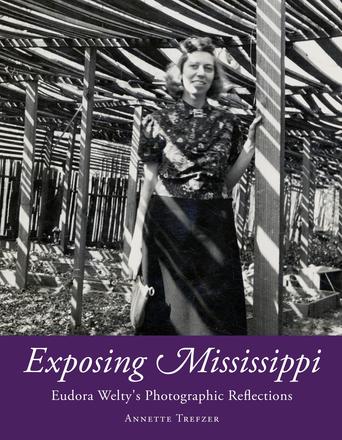
2022, Exposing Mississippi: Eudora Welty's Photographic Reflections, by Annette Trefzer, published by University Press of Mississippi
Internationally known as a writer, Eudora Welty has as well been spotlighted as a talented photographer. The prevalent idea remains that Welty simply took snapshots before she found her true calling as a renowned fiction writer. But who was Welty as a photographer? What did she see? How and why did she photograph? And what did Welty know about modern photography? In Exposing Mississippi: Eudora Welty's Photographic Reflections, Annette Trefzer elucidates Welty’s photographic vision and answers these questions by exploring her photographic archive and writings on photography.
The photographs Welty took in the 1930s and ’40s frame her visual response to the cultural landscapes of the segregated South during the Depression. The photobook One Time, One Place, which was selected, curated, and shaped into a visual narrative by Welty herself, serves as a starting point and guide for the chapters on her spatial hermeneutic. The book is divided into sections by locations and offers how the framing of these areas reveals Welty’s radical commentary of the spaces her camera captured. There are over eighty images in Exposing Mississippi, including some never-before-seen archival photographs, and sections of the book draw on over three hundred more. The chapters on institutional, leisure, and memorial landscapes address how Welty’s photographs contribute to, reflect on, and intervene in customary visual constructions of the Depression-era South.
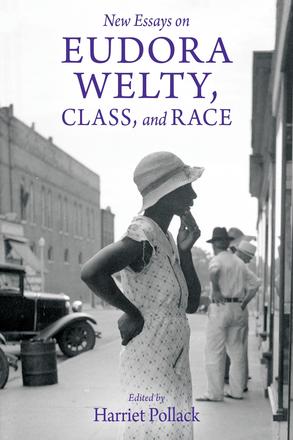
2019 New Essays on Eudora Welty, Class, and Race, edited by Harriet Pollack, published by University of Mississippi Press
"A groundbreaking work on race and class in the remarkable writer’s fiction and photography. Contributions by Jacob Agner, Susan V. Donaldson, Sarah Gilbreath Ford, Stephen M. Fuller, Jean C. Griffith, Ebony Lumumba, Rebecca Mark, Donnie McMahand, Kevin Murphy, Harriet Pollack, Christin Marie Taylor, Annette Trefzer, and Adrienne Akins Warfield. The year 2013 saw the publication of Eudora Welty, Whiteness, and Race, a collection in which twelve critics changed the conversation on Welty’s fiction and photography by mining and deciphering the complexity of her responses to the Jim Crow South. The thirteen diverse voices in New Essays on Eudora Welty, Class, and Race deepen, reflect on, and respond to those seminal discussions. These essays freshly consider such topics as Welty’s uses of African American signifying in her short stories and her attention to public street performances interacting with Jim Crow rules in her unpublished photographs. Contributors discuss her adaptations of gothic plots, haunted houses, Civil War stories, and film noir. And they frame Welty’s work with such subjects as Bob Dylan’s songwriting, the idea and history of the orphan in America, and standup comedy. They compare her handling of whiteness and race to other works by such contemporary writers as William Faulkner, Richard Wright, Toni Morrison, Chester Himes, and Alice Walker. Discussions of race and class here also bring her masterwork The Golden Apples and her novel Losing Battles, underrepresented in earlier conversations, into new focus. Moreover, as a group these essays provide insight into Welty as an innovative craftswoman and modernist technician, busily altering literary form with her frequent, pointed makeovers of familiar story patterns, plots, and genres."
2018 Teaching Eudora Welty: Twenty-First-Century Approaches, edited by Mae Miller Claxton and Julia Eichelberger, published by the University of Mississippi Press
"The essays collected in Teaching the Works of Eudora Welty seek to move Welty beyond a discussion of region and reflect new scholarship that remaps her work onto a larger canvas. The book offers ways to help twenty-first-century readers navigate Welty's challenging and intricate narratives. It provides answers to questions many teachers will have: Why should I study a writer who documents white privilege? Why should I give this "regional" writer space on an already crowded syllabus? Why should I teach Welty if I do not study the South? How can I help my students make sense of her modernist narratives? How can Welty's texts help me teach my students about literary theory, about gender and disability, about cultures and societies with which my students are unfamiliar?"

2016 Eudora Welty's Fiction and Photography: The Body of the Other Woman, by Harriet Pollack, published by the University of Georgia Press
"Drawing on the context in which the protection of the white female body is symbolically linked with guarding the U.S. southern body politic, Harriet Pollack traces a pattern in Eudora Welty’s fiction in which a sheltered middle-class daughter is disturbed or delighted by an other-class woman who takes pleasure in “making a spectacle” of her corporeal self. Welty herself seeks a parallel self-exposure both through these stories that pair protected girls with at-risk flashers and through her photography’s innovating representations of the black female body. Welty’s escape from sheltering continues when, after finding herself in love with a man unwilling to acknowledge his homosexuality and so sharing the silence of his closet, she varies the plot of the other woman in a series of midcareer fictions."

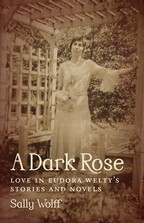
2015 A Dark Rose: Love in Eudora Welty's Stories and Novels, by Sally Wolff King, published by the Louisiana State University Press
2013 Eudora Welty and Surrealism, by Stephen M. Fuller, published by the University of Mississippi Press
"Eudora Welty and Surrealism surveys Welty's fiction during the most productive period of her long writing life. The study shows how the 1930s witnessed surrealism's arrival in the United States largely through the products of its visual artists. Welty, a frequent traveler to New York City where the surrealists exhibited and a keen reader of magazines and newspapers that disseminated their work, absorbed and unconsciously appropriated surrealism's perspective in her writing. In fact, Welty's first solo exhibition of her photographs in 1936 took place next door to New York's premier venue for surrealist art. In a series of readings that collectively examine A Curtain of Green and Other Stories, The Wide Net and Other Stories, Delta Wedding, The Golden Apples, and The Bride of the Innisfallen and Other Stories, the book reveals how surrealism profoundly shaped Welty's striking figurative literature. Yet the influence of the surrealist movement extends beyond questions of style."

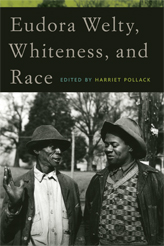
2013 Eudora Welty, Whiteness, and Race, edited by Harriet Pollack, published by the University of Georgia Press
"Faced with Eudora Welty's preference for the oblique in literary performances, some have assumed that Welty was not concerned with issues of race, or even that she was perhaps ambivalent toward racism. This collection counters those assumptions as it examines Welty's handling of race, the color line, and Jim Crow segregation and sheds new light on her views about the patterns, insensitivities, blindness, and atrocities of whiteness. Contributors to this volume show that Welty addressed whiteness and race in her earliest stories, her photography, and her first novel, Delta Wedding. In subsequent work, including The Golden Apples, The Optimist's Daughter, and her memoir, One Writer's Beginnings, she made the color line and white privilege visible, revealing the gaping distances between lives lived in shared space but separated by social hierarchy and segregation. Even when black characters hover in the margins of her fiction, they point readers toward complex lives, and the black body is itself full of meaning in her work. Several essays suggest that Welty represented race, like gender and power, as a performance scripted by whiteness. Her black characters in particular recognize whiteface and blackface as performances, especially comical when white characters are unaware of their role play."